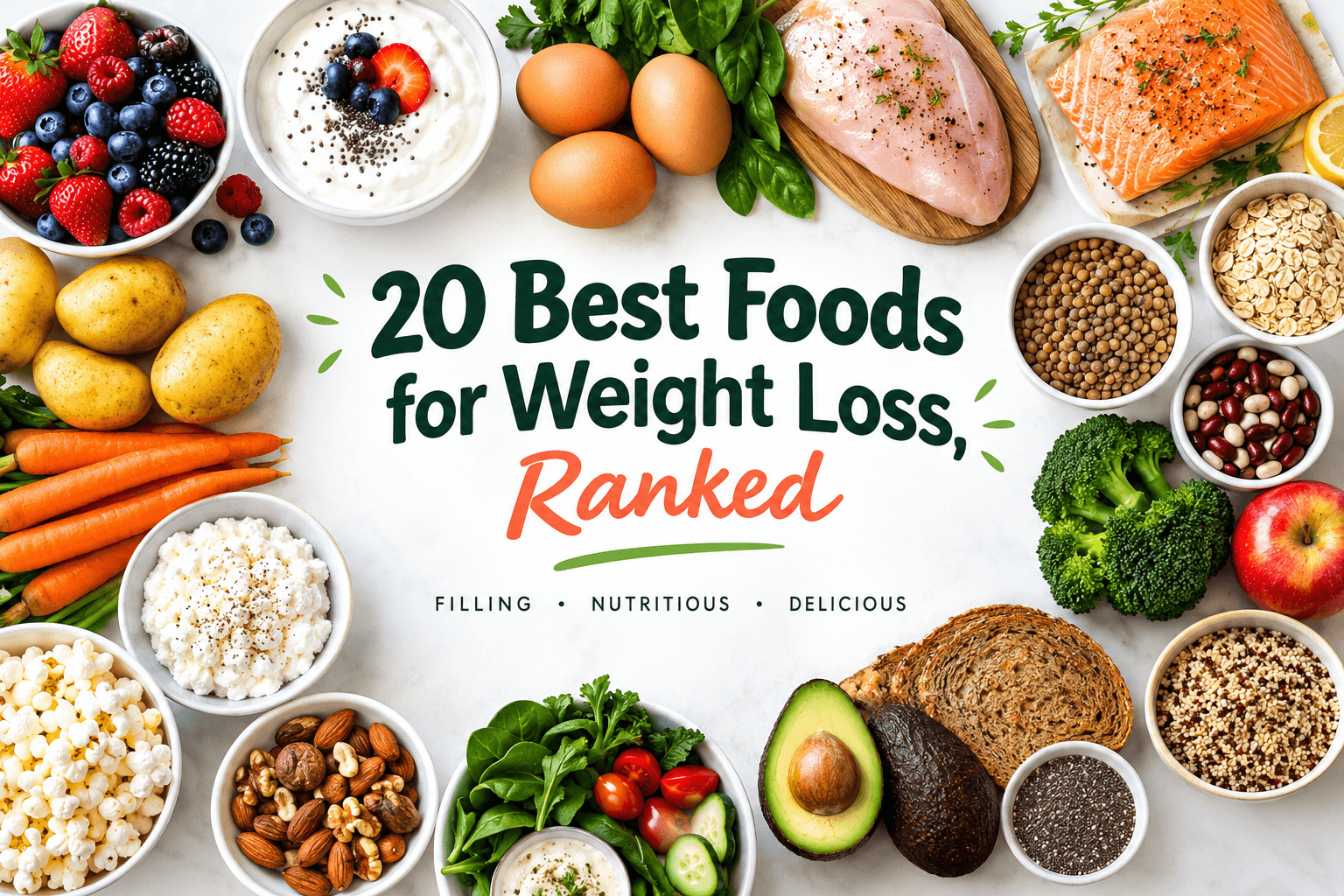
Looking for the best foods for weight loss? The foods that make losing weight easier tend to have one thing in common: they help you feel full without adding a huge number of calories.
Protein-rich foods, vegetables, fruit, legumes, whole grains, and a few calorie-dense foods such as nuts can all have a place in a weight-loss diet. Higher protein intake can increase feelings of fullness, while dietary fiber can help with appetite and energy intake.
But there is an important distinction: no individual food magically burns fat. A systematic review of 152 randomized controlled trials found that individual foods or food groups generally produced no or only trivial weight loss when considered on their own.
So, what are the best foods to eat when you’re trying to lose weight?
Here are my 20 best foods for weight loss, ranked.
The 20 Best Foods for Weight Loss
| Rank | Food | Why it is useful for weight loss |
|---|---|---|
| 1 | Potatoes | Extremely filling for relatively few calories |
| 2 | Eggs | High-quality protein and highly versatile |
| 3 | Greek yogurt | High in protein and easy to portion |
| 4 | Chicken breast | Very high in protein with relatively few calories |
| 5 | Oats | High in fiber and very filling |
| 6 | Lentils | Combination of protein, fiber and slow-digesting carbs |
| 7 | Fish | Protein-rich and nutrient-dense |
| 8 | Berries | High in fiber and relatively low in calories |
| 9 | Cottage cheese | Protein-rich and filling |
| 10 | Beans | High in both protein and fiber |
| 11 | Broccoli | Extremely low in calories and high in volume |
| 12 | Apples | Fiber-rich and convenient |
| 13 | Lean beef | Protein-rich and satisfying |
| 14 | Popcorn | High-volume snack when prepared without lots of added fat |
| 15 | Avocado | Nutrient-dense and satisfying, but calorie-dense |
| 16 | Carrots | Low-calorie, crunchy and filling |
| 17 | Whole-grain bread | More fiber and nutrients than refined bread |
| 18 | Quinoa | Provides protein, fiber and carbohydrates |
| 19 | Nuts | Very nutritious and satisfying, but easy to overeat |
| 20 | Chia seeds | Extremely high in fiber and useful for adding satiety |
Let’s look at each one in more detail.
1. Potatoes
Potatoes may seem like an unlikely food to put at number one, but they can be extremely useful when you’re trying to lose weight.
Boiled or baked potatoes provide a lot of food volume for relatively few calories. They are also a good source of potassium and carbohydrates.
The important part is how you prepare them.
A boiled potato is very different from a large portion of deep-fried fries covered in oil.
Best ways to eat potatoes for weight loss
- Boiled potatoes
- Baked potatoes
- Air-fried potatoes
- Potato salad with a light dressing
- Boiled potatoes with vegetables and lean protein
Instead of eliminating potatoes because you’re trying to lose weight, consider using them as your main carbohydrate source while controlling added fats.
Weight-loss tip: Potatoes become considerably more calorie-dense when you add large amounts of butter, oil, cheese or creamy sauces.
2. Eggs
Eggs are one of the most versatile protein-rich foods you can eat.
One large egg provides roughly 6 grams of protein along with a variety of vitamins and minerals.
Eggs are particularly useful for breakfast because they can form the foundation of a high-protein meal.
Try combining:
Eggs + vegetables + fruit
rather than:
Eggs + bacon + buttered toast + cheese
The first combination can provide substantial food volume without an enormous calorie load.
Easy weight-loss meals with eggs
- Omelet with vegetables
- Boiled eggs with whole-grain toast
- Scrambled eggs with spinach
- Egg and vegetable breakfast bowl
- Eggs with avocado and tomatoes
3. Greek Yogurt
Greek yogurt is one of the easiest foods to add to a high-protein weight-loss diet.
Choose a plain Greek yogurt rather than a heavily sweetened flavored version.
Depending on the product, Greek yogurt can provide a substantial amount of protein per serving.
It also works as a replacement for higher-calorie ingredients such as mayonnaise, sour cream or cream.
Try Greek yogurt with:
- Berries
- Cinnamon
- Chia seeds
- Ground flaxseed
- A small amount of nuts
- Oats
If you’re watching calories closely, compare the nutrition labels because Greek yogurt can vary dramatically in fat and calories.
4. Chicken Breast
Chicken breast is almost a classic weight-loss food for a reason.
It provides a lot of protein relative to its calorie content and is extremely versatile.
Protein can be particularly useful during weight loss because higher-protein diets can increase feelings of fullness. Systematic reviews have found evidence that increased protein intake can improve satiety, although the strength of the evidence varies between studies.
Make chicken more interesting
You don’t need to eat plain grilled chicken every day.
Try:
- Chicken stir-fry
- Chicken salad
- Chicken fajitas
- Chicken curry
- Chicken and roasted vegetables
- Chicken soup
The biggest calorie trap is often the sauce, oil or cooking method rather than the chicken itself.
5. Oats
Oats are an excellent source of carbohydrates and dietary fiber.
They are especially useful at breakfast because they can be combined with protein-rich foods to create a very filling meal.
For example:
Oats + Greek yogurt + berries + cinnamon
provides carbohydrates, protein and fiber in one meal.
Oats also contain beta-glucan, a soluble fiber that has been studied for its effects on appetite and metabolic health. Research on dietary fiber suggests that some more viscous fibers can have greater effects on appetite than others.
Best oats for weight loss
Choose:
- Rolled oats
- Steel-cut oats
- Plain oatmeal
Be more careful with flavored instant oatmeal products because added sugar can significantly increase calories.
6. Lentils
Lentils are one of the most underrated weight-loss foods.
They combine protein, fiber and carbohydrates in a single food.
That combination makes lentils substantially more satisfying than many refined carbohydrate foods.
Recent research is particularly interesting here. A 2026 systematic review and meta-analysis of 36 randomized trials found that non-soy legumes were associated with reductions in body weight, waist circumference and fat mass, although the researchers also noted that more high-quality trials are needed.
Use lentils in:
- Soups
- Salads
- Curries
- Stews
- Lentil burgers
- Grain bowls
7. Fish
Fish is an excellent source of protein and can be an important part of a weight-loss diet.
Lean fish such as cod, haddock and pollock provide lots of protein without many calories.
Fatty fish such as salmon contain more calories because of their fat content, but they also provide valuable omega-3 fatty acids.
So don’t avoid fatty fish simply because you’re losing weight.
Instead, control the portion.
Great choices
- Cod
- Haddock
- Tuna
- Salmon
- Sardines
- Trout
- Mackerel
A large systematic review of randomized trials found that increasing fish consumption was associated with a small reduction in body weight, although the certainty of evidence was low and the effect was small.
8. Berries
Berries are among the best fruits to include in a weight-loss diet.
They provide fiber, vitamins, minerals and plant compounds while generally being relatively low in calories.
Good choices include:
- Strawberries
- Blueberries
- Raspberries
- Blackberries
Raspberries and blackberries are particularly useful when you’re looking for a fruit with a lot of fiber.
Easy idea
Add berries to:
Greek yogurt + cinnamon + chia seeds
for a simple high-protein breakfast or dessert.
Fruit consumption overall is associated with a lower risk of overweight and obesity in observational evidence, although this doesn’t mean fruit itself causes weight loss.
9. Cottage Cheese
Cottage cheese is another convenient high-protein food.
It works particularly well as a snack because it requires almost no preparation.
Try it with:
- Berries
- Apple
- Cucumber
- Tomato
- Black pepper
- Cinnamon
Check the label because different cottage cheese products can vary substantially in protein and fat content.
10. Beans
Beans deserve a place near the top of any list of filling foods.
They contain both protein and fiber, making them considerably more satisfying than many refined carbohydrate foods.
Examples include:
- Kidney beans
- Black beans
- Cannellini beans
- Pinto beans
- Navy beans
Beans can replace some of the meat or refined carbohydrates in meals while increasing fiber intake.
For example:
Chicken + beans + vegetables + salsa
can make a very filling meal.
Research examining dietary patterns consistently finds associations between higher legume intake and healthier weight outcomes.
11. Broccoli
Broccoli is one of the easiest foods to use when you want to increase meal volume without dramatically increasing calories.
You can eat a large portion of broccoli for relatively few calories.
That’s useful because food volume matters when you’re trying to eat fewer calories without constantly feeling hungry.
Other excellent vegetables
- Cauliflower
- Cabbage
- Zucchini
- Green beans
- Spinach
- Mushrooms
- Peppers
- Asparagus
A useful rule is to make vegetables a major component of lunch and dinner.
12. Apples
Apples are portable, naturally sweet and relatively high in fiber compared with many snack foods.
Most importantly, an apple can replace a much more calorie-dense snack.
Instead of:
Cookies + coffee
try:
Apple + Greek yogurt
You get sweetness plus protein and fiber.
Eating fruit whole is generally preferable to drinking fruit juice when your goal is fullness because the whole fruit retains its structure and fiber.
13. Lean Beef
Beef can absolutely be part of a weight-loss diet.
The key is choosing leaner cuts and controlling portions.
Lean beef provides:
- Protein
- Iron
- Zinc
- Vitamin B12
Good choices include lean minced beef and leaner steak cuts.
You don’t need to eliminate red meat to lose weight, but it shouldn’t automatically be treated as a “free food.” Calories still count.
Pair a moderate serving of beef with a large portion of vegetables and a sensible carbohydrate source.
14. Popcorn
Popcorn can be a surprisingly good weight-loss snack.
Plain air-popped popcorn provides a large amount of food volume for relatively few calories.
The problem is what gets added to it.
A large bowl of popcorn can become a very different food when covered in:
- Butter
- Oil
- Caramel
- Cheese
- Sugar
For a lower-calorie snack, choose air-popped popcorn and season it with spices.
Try:
Paprika + garlic powder + black pepper
instead of butter-heavy toppings.
15. Avocado
Avocado is nutritious and contains fiber and predominantly unsaturated fats.
However, it is also relatively high in calories.
That makes avocado a perfect example of why healthy food doesn’t automatically mean low-calorie food.
A sensible serving can work very well in a weight-loss diet.
But eating an entire avocado alongside other calorie-dense foods can add several hundred calories to a meal.
Use avocado with:
- Eggs
- Salads
- Whole-grain toast
- Chicken
- Fish
- Bean bowls
16. Carrots
Carrots are inexpensive, convenient and naturally sweet.
They are particularly useful as a snack because they provide crunch and volume without a huge calorie load.
Try raw carrots with a protein-rich dip such as Greek-yogurt-based dip.
This can be much more satisfying than reaching for chips or crackers.
17. Whole-Grain Bread
You don’t have to eliminate bread to lose weight.
Whole-grain bread can be a nutritious carbohydrate source and generally provides more fiber than refined white bread.
Look for bread where a whole grain is listed prominently in the ingredients and compare the nutrition labels.
One important caveat: whole grains are not a magic weight-loss food. Controlled trials have not consistently shown that simply increasing whole-grain intake causes meaningful weight loss by itself.
The advantage is that whole-grain foods can be part of an overall nutrient-dense diet.
18. Quinoa
Quinoa is technically a seed rather than a conventional cereal grain, but it is commonly used like a grain.
It provides:
- Protein
- Fiber
- Carbohydrates
- Minerals
Use quinoa as a base for a meal containing vegetables and protein.
For example:
Quinoa + chicken + broccoli + peppers
is a much more balanced meal than simply eating a large bowl of quinoa by itself.
19. Nuts
Nuts are one of the most interesting foods on this list.
They’re high in calories and fat, so they might seem like a poor choice for weight loss.
But they are also rich in protein, fiber and unsaturated fats and can be very satisfying.
Research has found an association between higher nut consumption and lower risk of overweight and obesity. However, randomized trials suggest the direct weight-loss effect is small.
The trick is portion control.
A small handful can be a great snack.
Eating several handfuls while watching television is another story.
20. Chia Seeds
Chia seeds are tiny but extremely rich in fiber.
They absorb water and form a gel-like texture, making them useful for increasing the texture and fiber content of meals.
Try adding a tablespoon to:
- Greek yogurt
- Oatmeal
- Smoothies
- Chia pudding
- Overnight oats
But remember that chia seeds aren’t calorie-free. A tablespoon or two is usually plenty.
What Makes a Food Good for Weight Loss?
Looking at the list above, you’ll notice that the foods have several characteristics in common.
1. Protein
Protein tends to be more satiating than carbohydrate or fat and can help make meals more filling.
Research suggests that higher-protein diets can improve satiety in people with overweight or obesity, although the evidence isn’t perfect.
Good protein sources include:
- Eggs
- Greek yogurt
- Chicken
- Fish
- Cottage cheese
- Lean beef
- Beans
- Lentils
2. Fiber
Fiber can increase the volume of food without contributing as many calories as fat.
High-fiber foods include:
- Vegetables
- Fruit
- Beans
- Lentils
- Oats
- Whole grains
- Chia seeds
However, fiber isn’t a magic appetite suppressant. Research shows that its effects vary considerably depending on the type and amount of fiber.
3. Low Energy Density
Energy density refers to how many calories a food contains relative to its weight.
Vegetables, fruit and many potatoes are relatively low in energy density.
This means you can often eat a large physical portion without consuming enormous numbers of calories.
4. Nutrient Density
The best weight-loss foods aren’t simply foods with the fewest calories.
You also want vitamins, minerals, protein, fiber and other beneficial nutrients.
That’s why a diet consisting almost entirely of extremely low-calorie foods isn’t necessarily a good strategy.
The Best Weight-Loss Meal Formula
Instead of obsessing over individual foods, use this simple formula:
Protein + vegetables + high-fiber carbohydrate + controlled fat
For example:
Chicken + broccoli + potatoes + olive oil
or:
Salmon + vegetables + quinoa
or:
Greek yogurt + berries + oats + chia seeds
This approach makes it easier to create filling meals without excessive calories.
Harvard’s Healthy Eating Plate similarly emphasizes vegetables and fruit, whole grains and healthy protein sources as components of a balanced diet.
What About “Fat-Burning” Foods?
You may have heard claims that certain foods “boost your metabolism” or “burn belly fat.”
Be skeptical.
There is no ordinary food that will magically cause significant amounts of body fat to disappear.
Weight loss primarily occurs when you consistently consume fewer calories than your body uses.
Some foods can make that calorie deficit easier to maintain because they provide more fullness, protein, fiber or food volume.
That’s a much more useful way to think about weight-loss foods.
The 5 Best Foods to Eat When You’re Hungry
If hunger is your biggest problem during weight loss, start with foods that combine protein, fiber and volume.
My five practical choices are:
1. Greek yogurt + berries
High protein, relatively low calorie and naturally sweet.
2. Eggs + vegetables
A protein-rich meal with plenty of volume.
3. Potatoes + lean protein
A surprisingly filling combination.
4. Lentil soup
Protein, fiber, liquid and plenty of volume.
5. Chicken + a huge serving of vegetables
Simple, filling and easy to customize.
Foods to Limit When Trying to Lose Weight
You don’t need to completely eliminate any particular food group.
However, some foods make it extremely easy to consume a lot of calories without feeling particularly full.
These include:
- Sugary drinks
- Candy
- Pastries
- Cookies
- Chips
- Ice cream
- Fast food
- Highly processed snack foods
- Large amounts of alcohol
- Large amounts of added fats
The problem isn’t necessarily that these foods are “bad.”
It’s that they can be very calorie-dense and easy to overeat.
For example, drinking 500 calories of sugary beverages can be much less filling than eating 500 calories of potatoes, vegetables and lean protein.
Can You Eat Carbs and Still Lose Weight?
Absolutely.
Potatoes, oats, fruit, beans, lentils, quinoa and whole grains can all fit into a weight-loss diet.
The important factor is your total calorie intake and overall dietary pattern, not whether a food contains carbohydrates.
In fact, completely eliminating carbohydrates isn’t necessary for long-term weight management. Research comparing cereal- and legume-containing diets does not show a clear long-term weight-loss advantage from simply restricting these foods.
Can You Eat Fat and Still Lose Weight?
Yes.
Foods such as:
- Avocado
- Nuts
- Olive oil
- Fatty fish
- Seeds
can be part of a healthy diet.
But fat contains approximately twice as many calories per gram as protein or carbohydrates.
That means calorie-dense foods deserve more attention to portion size when you’re trying to lose weight.
The Bottom Line
The best foods for weight loss aren’t necessarily the foods with the fewest calories.
The most useful foods are those that help you build satisfying meals while keeping your overall calorie intake under control.
If you want to make weight loss easier, focus on:
Protein + fiber + vegetables + fruit + minimally processed foods + sensible portions.
And remember that the ranking in this article is a practical ranking, not a scientific hierarchy. There is no evidence that eating potatoes instead of eggs, for example, will automatically produce greater fat loss. Research suggests that individual foods generally have relatively small effects compared with the overall diet and calorie intake.
The best food for weight loss is ultimately the one that keeps you full, fits your calorie target, provides useful nutrients, and is something you can happily eat again tomorrow.
Frequently Asked Questions
What is the number one food for weight loss?
There isn’t a scientifically established single “best” food for weight loss. Potatoes rank highly in this practical list because they can provide substantial food volume for relatively few calories. The overall diet matters much more than any individual food.
What foods help burn belly fat?
No individual food specifically burns belly fat. Reducing overall body fat requires a sustained calorie deficit. Foods high in protein, fiber and water can make that process easier by helping with fullness.
What should I eat when trying to lose weight?
Build meals around protein, vegetables, fruit and high-fiber carbohydrate sources such as potatoes, oats, beans and lentils. Keep calorie-dense foods such as oils, nuts and cheese to sensible portions.
Are eggs good for weight loss?
Yes. Eggs provide high-quality protein and can be part of a filling, calorie-controlled meal. Their effect on weight depends on the overall diet and portion sizes.
Are potatoes good for weight loss?
Yes. Boiled and baked potatoes can be surprisingly filling for their calorie content. The main issue is what you add to them—large amounts of butter, oil, cheese or creamy sauces can significantly increase the calorie content.
Can I eat fruit while trying to lose weight?
Yes. Whole fruit can be an excellent choice during weight loss because it provides fiber, water and nutrients. Berries, apples and other whole fruits can replace higher-calorie snacks.
What foods keep you full the longest?
Foods combining protein, fiber and food volume tend to be particularly useful. Examples include potatoes, eggs, Greek yogurt, lentils, beans, vegetables and lean protein.
What is the best breakfast for weight loss?
A high-protein, high-fiber breakfast is a good starting point. For example, Greek yogurt with berries, oats and chia seeds can provide protein, fiber and carbohydrates in one meal.