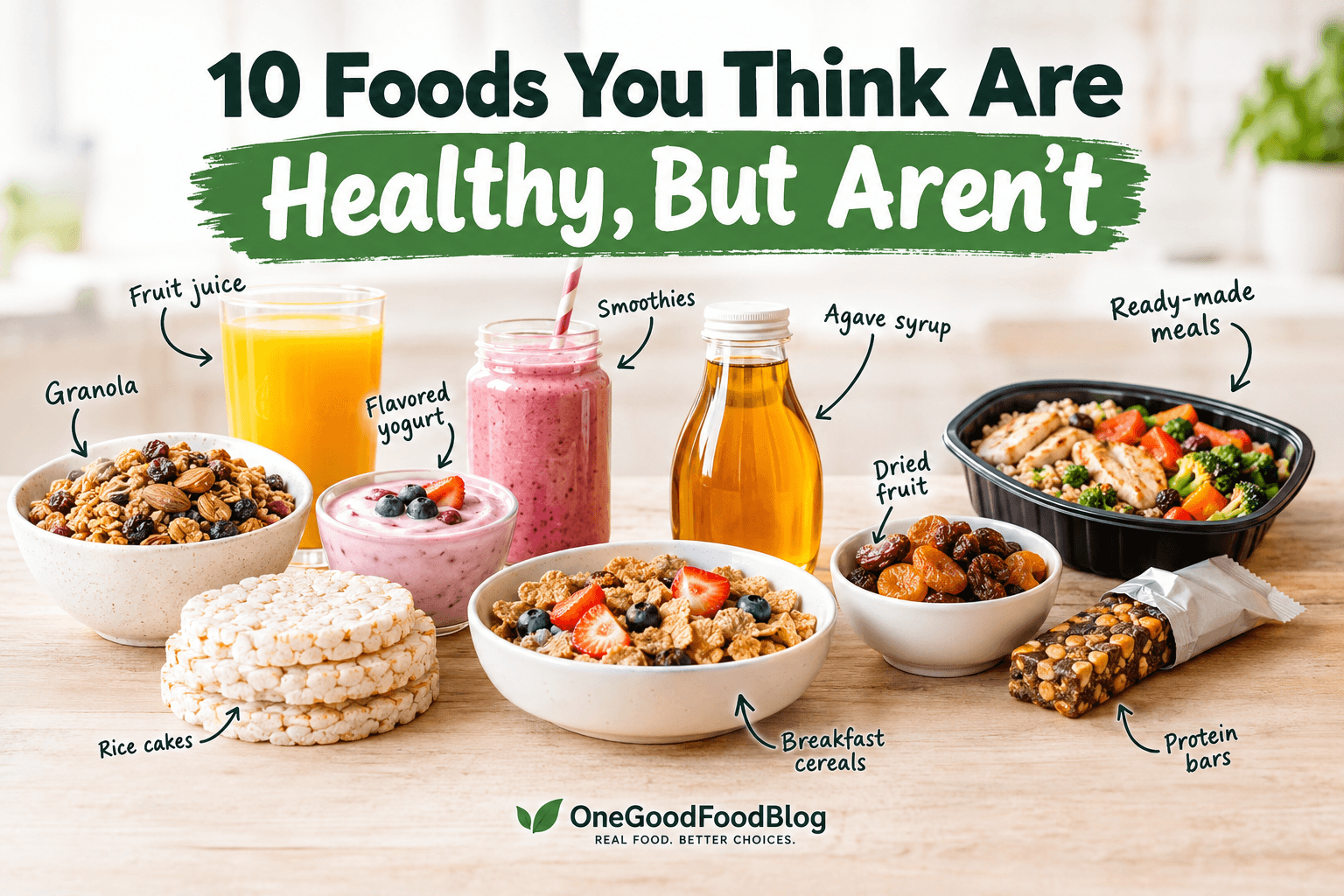
You probably already know that candy, soda and fast food aren’t exactly health foods.
But what about granola, fruit juice, smoothies and protein bars?
These foods have a healthy reputation. They’re often associated with fitness, weight loss and good nutrition. Yet some versions can contain surprisingly large amounts of sugar, calories, refined carbohydrates or highly processed ingredients.
That doesn’t mean these foods are automatically unhealthy.
The real problem is the health halo: when a food sounds healthy, we tend to underestimate how much we’re eating or assume we can eat it freely.
So, which foods should you look at more carefully?
Here are 10 foods you think are healthy but aren’t always as healthy as they seem.
1. Granola
Granola might be one of the biggest examples of a food with a health halo.
The basic ingredients can certainly be nutritious. Oats provide carbohydrates and fiber, while nuts and seeds provide protein, minerals and unsaturated fats.
The problem is what can be added during processing.
Many commercial granolas contain combinations of:
- Sugar
- Honey
- Syrups
- Dried fruit
- Added oils
- Chocolate
- Coconut
That can make granola extremely calorie-dense.
A bowl that looks like a healthy breakfast can therefore contain considerably more calories than you expect.
Is granola unhealthy?
Not necessarily.
The problem is that granola is easy to overeat. A small serving can be quite energy-dense, particularly when combined with full-fat yogurt, fruit, honey or nut butter.
A healthier choice
Try plain oats or a low-sugar muesli instead.
You can make your own granola using oats, nuts, seeds and a small amount of sweetener, giving you much more control over the ingredients.
Bottom line: Granola can be nutritious, but don’t assume that all granola is a healthy, low-calorie breakfast.
2. Fruit Juice
If fruit is healthy, fruit juice must be healthy too.
Right?
Not quite.
One of the important differences between whole fruit and fruit juice is how easy it is to consume.
Eating an orange takes time and provides fiber. Drinking orange juice takes seconds.
You can easily drink the juice from several pieces of fruit without experiencing the same level of fullness you would get from eating the whole fruit.
The World Health Organization considers sugars naturally present in fruit juice to be free sugars and recommends keeping free sugar intake below 10% of total energy intake, with additional benefits from staying below 5%.
Is fruit juice unhealthy?
Fruit juice isn’t the same thing as soda, and it can contain vitamins and other nutrients.
But that doesn’t make it nutritionally equivalent to whole fruit.
A healthier choice
Eat the fruit instead.
Choose:
Orange → orange juice
Apple → apple juice
Whole berries → berry juice
The whole fruit generally gives you more fiber and takes longer to consume.
Bottom line: Fruit is healthy. That doesn’t mean you should drink unlimited amounts of fruit juice.
3. Flavored Yogurt
Yogurt can be an excellent food.
It can provide protein, calcium and other nutrients.
But flavored yogurt can be very different from plain yogurt.
Some fruit-flavored and dessert-style yogurts contain significant amounts of added sugar.
The word “yogurt” on the label can therefore create a health halo that makes us overlook the rest of the ingredient list.
Is flavored yogurt unhealthy?
Not necessarily.
Some flavored yogurts can fit perfectly well into a healthy diet.
The key is checking the nutrition label and comparing products.
A healthier choice
Start with plain Greek yogurt or natural yogurt and add your own:
- Berries
- Apple
- Cinnamon
- Nuts
- Chia seeds
- Ground flaxseed
This gives you much more control over sweetness and calories.
Bottom line: Plain yogurt is often a better everyday choice than heavily sweetened flavored yogurt.
4. Smoothies
Smoothies are another food that can be genuinely healthy—or surprisingly calorie-dense.
A homemade smoothie made with vegetables, berries and plain yogurt can be an excellent way to consume nutritious foods.
But consider what can happen when a smoothie contains:
- Two bananas
- A large handful of berries
- Fruit juice
- Honey
- Yogurt
- Nut butter
Suddenly, you’ve created a very energy-dense drink.
The problem isn’t that these ingredients are necessarily bad.
It’s that liquid food can be very easy to consume quickly.
Are smoothies healthy?
They can be.
The ingredients and portion size matter.
A smoothie containing whole fruit, vegetables and a protein source is very different from a large commercial smoothie containing fruit juice, syrups and sweetened ingredients.
A healthier smoothie
Try:
Greek yogurt + berries + milk or water + a small amount of seeds
Keep the portion reasonable and remember that a smoothie still counts as food.
Bottom line: A smoothie can be healthy, but “smoothie” doesn’t automatically mean low-calorie.
5. Agave Syrup
Agave syrup has often been promoted as a healthier alternative to ordinary sugar.
It sounds appealing:
Natural.
Plant-based.
Better than sugar.
But “natural” doesn’t automatically mean healthy.
Agave syrup is still a concentrated sweetener.
The WHO includes sugars naturally present in honey and syrups within its definition of free sugars.
Is agave syrup healthier than sugar?
Replacing one concentrated sweetener with another doesn’t suddenly make a food healthy.
The bigger win is usually reducing how much sweetness you consume overall.
A healthier approach
Instead of searching for the “healthiest” sugar, try gradually reducing the amount of added sweetener in your diet.
Use cinnamon, vanilla, berries or other naturally flavorful ingredients to make foods taste sweeter without adding large amounts of sugar.
Bottom line: Agave syrup may be marketed as a healthier sweetener, but it’s still a concentrated source of sugar.
6. Rice Cakes
Rice cakes are a classic diet food.
They’re light, crunchy and relatively low in calories per individual cake.
That sounds perfect for weight loss.
But there’s a downside.
Rice cakes generally provide relatively little protein, fat and fiber. As a result, they may not be particularly filling.
You might eat two rice cakes, still feel hungry and then reach for another snack shortly afterward.
Are rice cakes healthy?
They’re not necessarily unhealthy.
They’re simply not particularly nutrient-dense on their own.
A better snack
If you like rice cakes, add something that provides protein or healthy fat.
For example:
- Rice cake + cottage cheese
- Rice cake + egg
- Rice cake + peanut butter
- Rice cake + avocado
That combination is more satisfying than rice cakes alone.
Bottom line: Rice cakes aren’t junk food, but they aren’t a nutritional miracle either.
7. “Healthy” Breakfast Cereals
Walk through the breakfast aisle and you’ll find products covered in health claims:
Whole grain
High fiber
Natural
Source of vitamins
Heart healthy
These claims can make a cereal appear healthier than it actually is.
Some breakfast cereals contain substantial amounts of added sugar while providing relatively little protein.
And a cereal can contain whole grains while still being highly processed and sweetened.
How to choose a better cereal
Don’t rely on the front of the box.
Turn it around and check:
- Sugar
- Fiber
- Protein
- Saturated fat
- Ingredients
- Serving size
Plain oats are a simple alternative.
You can add berries, nuts, seeds, cinnamon or yogurt yourself.
Bottom line: “Whole grain” doesn’t automatically mean “healthy.” Look at the complete nutrition label.
8. Dried Fruit
Dried fruit is an interesting one because the food itself isn’t necessarily unhealthy.
Raisins are still grapes.
Dried apricots are still apricots.
Dates are still dates.
But removing water dramatically changes how easy it is to eat large amounts.
Imagine eating a large bowl of grapes.
Now imagine eating all the grapes that went into a much smaller bowl of raisins.
The second option is much easier to consume quickly.
Some dried fruit products also contain added sugar.
Is dried fruit healthy?
It can absolutely be part of a healthy diet.
But portion size matters.
A healthier choice
Choose unsweetened dried fruit and keep portions relatively small.
If you’re trying to lose weight, fresh fruit may be easier to control because its high water content makes it more filling for the calories.
Bottom line: Dried fruit isn’t unhealthy, but it is much easier to overeat than fresh fruit.
9. Protein Bars
Protein bars have become one of the biggest health-food trends.
And there’s a good reason.
They’re convenient.
They’re portable.
And they can provide a useful amount of protein.
But some protein bars are essentially candy bars with extra protein.
Depending on the product, they can contain significant amounts of:
- Added sugar
- Fat
- Sweeteners
- Refined carbohydrates
- Calories
The phrase “high protein” doesn’t automatically make a product healthy.
Are protein bars healthy?
Some are excellent.
Others are little more than highly processed snack foods with a protein claim on the front.
Read the whole nutrition label rather than focusing only on protein grams.
Better everyday protein sources
Whenever practical, choose whole foods such as:
- Greek yogurt
- Eggs
- Cottage cheese
- Fish
- Chicken
- Lean meat
- Beans
- Lentils
Protein bars can still be useful when convenience matters.
Bottom line: A protein bar is a convenience food, not automatically a health food.
10. “Healthy” Ready-Made Meals
Ready-made meals can be incredibly convenient.
And convenience isn’t the enemy of healthy eating.
The problem comes when we assume that a meal labeled:
Healthy
Natural
Organic
Plant-based
or
Low-fat
must automatically be nutritious.
It doesn’t.
A ready-made meal can contain vegetables and whole grains while also being high in sodium, refined carbohydrates, saturated fat or calories.
Research on ultra-processed foods has also attracted considerable attention. A 2024 umbrella review in The BMJ found that higher exposure to ultra-processed foods was associated with several adverse health outcomes, although the strength and quality of evidence varied considerably between outcomes.
This doesn’t mean that every processed food is unhealthy.
Frozen vegetables, canned beans and plain yogurt are all processed foods and can be excellent choices.
The bigger issue is diets dominated by highly processed, energy-dense products.
A healthier approach
When buying a ready-made meal, check:
- Protein
- Fiber
- Calories
- Sugar
- Saturated fat
- Sodium
- Ingredient list
Don’t judge a meal by the marketing on the front of the package.
Bottom line: “Healthy” is a marketing claim—not a guarantee.
The Biggest Problem: The Health Halo
So what do granola, smoothies, protein bars and fruit juice have in common?
They can all benefit from a health halo.
A health halo occurs when one positive characteristic makes us perceive an entire food as healthier than it really is.
For example:
“It’s made with oats, so I can eat plenty of granola.”
“It’s made with fruit, so the smoothie must be low-calorie.”
“It’s a protein bar, so it must be healthy.”
“It’s natural sugar, so it doesn’t count.”
This can be particularly important if you’re trying to lose weight.
You can eat foods that sound incredibly healthy and still consume more calories than your body needs.
Healthy Doesn’t Mean Unlimited
This is perhaps the most important lesson.
A food doesn’t have to be “bad” to be something you should eat in moderation.
Nuts are nutritious—but extremely calorie-dense.
Olive oil is nutritious—but almost entirely fat.
Avocados contain beneficial nutrients—but they’re also energy-dense.
Dried fruit can provide nutrients—but it’s easy to overeat.
Granola can contain oats and nuts—but it can also contain lots of added sugar and calories.
Healthy eating is therefore not about finding a list of foods you can eat without limits.
It’s about understanding nutrient density, calorie density, processing and portion size.
What Should You Eat Instead?
A good starting point is to build most of your diet around foods that are relatively minimally processed and naturally rich in nutrients.
Think:
- Vegetables
- Whole fruit
- Eggs
- Fish
- Lean meat
- Beans and lentils
- Whole grains
- Nuts and seeds
- Plain yogurt
- Potatoes
- Other minimally processed foods
WHO guidance emphasizes dietary variety and recommends prioritizing fruits, vegetables, pulses and whole grains while limiting free sugars.
And remember:
Frozen doesn’t mean unhealthy.
Canned doesn’t mean unhealthy.
Processed doesn’t automatically mean unhealthy.
The better question is:
What happened to the food during processing, and what was added to it?
10 Foods You Think Are Healthy: Quick Summary
| Food | What to watch for | Better approach |
|---|---|---|
| Granola | Added sugar and calorie density | Oats or low-sugar muesli |
| Fruit juice | Free sugars and low satiety | Whole fruit |
| Flavored yogurt | Added sugar | Plain Greek yogurt |
| Smoothies | Large portions and hidden calories | Simple homemade smoothie |
| Agave syrup | Concentrated sugar | Use less sweetener |
| Rice cakes | Low protein and fiber | Add protein or healthy fat |
| Breakfast cereal | Added sugar | Plain oats |
| Dried fruit | Very easy to overeat | Fresh fruit |
| Protein bars | Highly processed ingredients | Whole-food protein |
| Ready-made meals | Sodium, calories and processing | Check the nutrition label |
The Bottom Line
You don’t need to eliminate these 10 foods from your diet.
In fact, some of them can be perfectly healthy choices.
The important lesson is to stop assuming that something is healthy simply because it looks healthy, sounds healthy or is marketed as healthy.
Instead, look at the entire picture:
What are the ingredients?
How much sugar does it contain?
How calorie-dense is it?
How much protein and fiber does it provide?
How processed is it?
And how much are you actually eating?
The healthiest food isn’t always the product with the most impressive packaging.
Sometimes, it’s simply the food with the shortest ingredient list.
Eat real food. Read the label. Question the health halo.